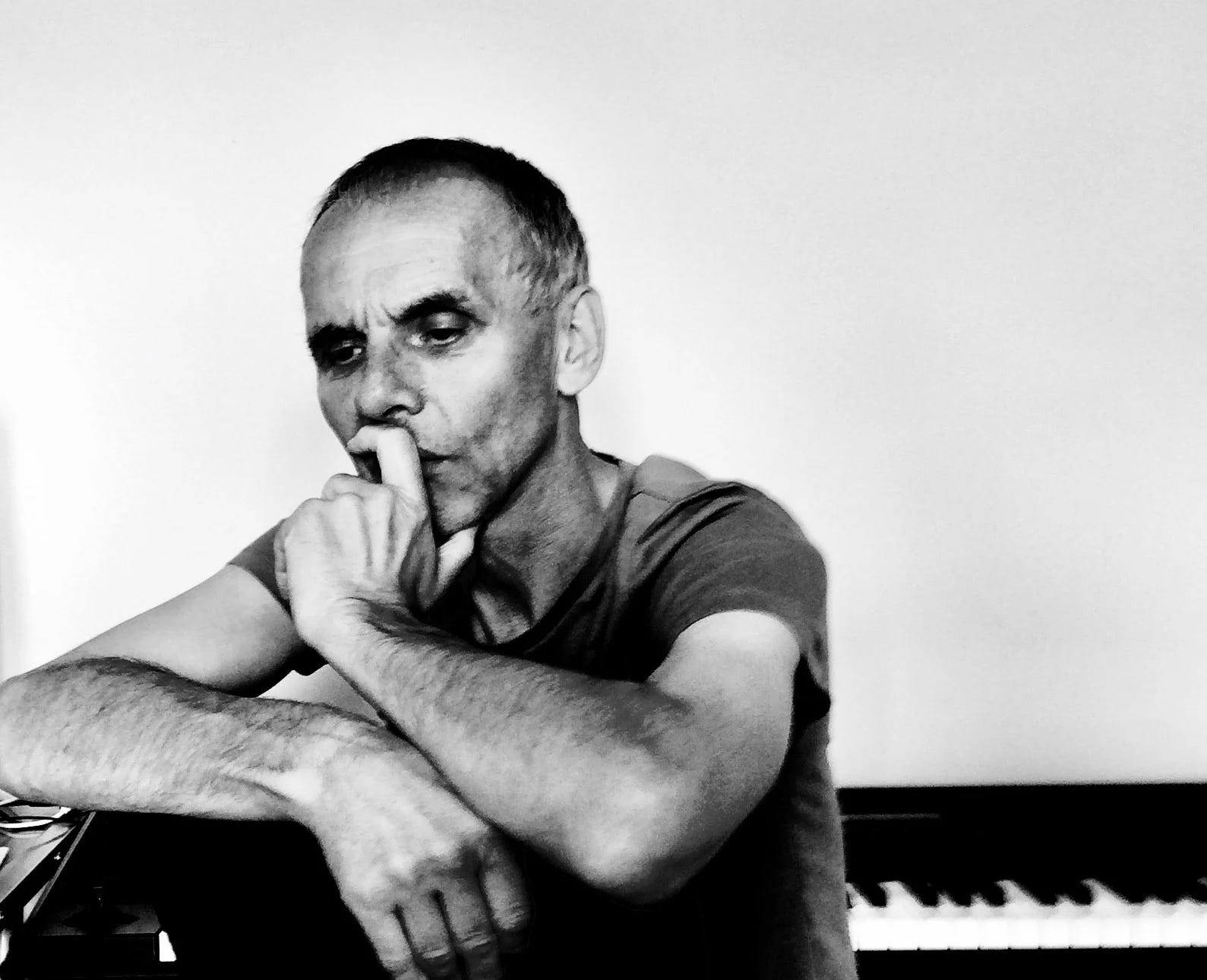
Robert Haigh
A conversation with the minimalist composer/ hardcore DnB pioneer on crafting ideal piano music for the bleakest part of winter
It’s that deep part of winter. That desolate, hostile, salt-blasted, barren, “the sun really is a cold, distant star” season that eradicates hope of warmth returning to the Northern Hemisphere. And I find that during this time, I turn to music that’s equally still and spare as the black tree branches. Minimal dub techno can scratch that itch sometimes (which reminds me to pull out some Vladislav Delay), but more often than not, I turn to solo piano music for a soundtrack.
This time of year invariably leads me back to the austere piano and electronics albums that British musician Robert Haigh recorded between 2017 and 2022 and released across a set of three albums for the Unseen Worlds imprint: Creatures of the Deep, Black Sarabande, Human Remains. They are beautiful, contemplative, yet enigmatic works. Read online comments and names like Erik Satie and Harold Budd get bandied about. If you are fans of their work, then you will find plenty within these Haigh albums.
“In a way, these three Unseen Worlds releases work together as a trilogy,” Haigh told me a few years back when I wrote a guide to his music for Bandcamp. And if you’re the type of music zealot who studies the liner notes and production credits, you may already know that Robert Haigh released contemplative modern classical albums—which occasionally tipped into dark ambient territory— decades before on Nurse With Wound’s esteemed label United Dairies. After that, Haigh vanished from view by the end of the 1980s, only to reemerge in the 21st century with more evocative piano music.
But did you know that there was also an “R. Haigh” who dropped a string of furious drum & bass 12”s starting in the early 1990s under the handle Omni Trio and who was a major player on the influential Hardcore and Jungle label Moving Shadow? By the end of the 20th century though, Omni Trio—if it really was more than one person—disbanded and disappeared. Stylistically, R. Haigh couldn’t have been further away on the musical spectrum from Robert Haigh, the classical pianist. They couldn’t possibly be the same person…or could they?
“Fundamentally, it’s all connected,” Haigh told me from his home in England, nestled in a Cornish village near Truro. Compared side-by-side, it’s fascinating to hear that same self-taught, exploratory way of music-making transposed on two very different manifestations: furious D’n’B and contemplative piano. But aren’t we all such contradictions?
We traded emails for a few weeks back in 2022 on the occasion of his album Human Remains to talk about his music.
Did you grow up with piano lessons? Or was there a moment when you were growing up that anticipated your path in music?
We never had a piano in the house growing up, but my older sister had guitar lessons at school. As she grew tired of playing it gradually came into my possession and I taught myself chords from books. I was about 12 or 13. The next significant moment was Bowie and Roxy Music on Top of the Pops. I must have been about 14 at this time. I was drawn to the futuristic sounds and alien look of Bowie and Roxy – and of course Brian Eno became a massive influence as I followed him through his solo career.
Also really significant around this time was the release of Faust Tapes. To promote the band, Virgin put it out at 50p. My sister, who’s a few years older than me, went out and bought a copy. She hated it and gave it to me. I didn’t like it much either at first, but I only had a couple of albums in my collection, so I persevered with it. After a while I found it compelling – it opened up a whole new way of hearing and thinking about music. I especially liked the juxtapositions – discordant/noisy alongside melodic/atmospheric, etc.
Over the next few years I found myself drawn to the weirder stuff – I became a massive Peter Hammill fan, I discovered Tangerine Dream and started to move towards (what was then known as) krautrock. By now I had relocated to London to attend art college, and punk/post-punk was happening. I was discovering the likes of Steve Reich and Philip Glass, Miles Davis and Coltrane –and as I said, I followed Eno as he ventured into his more adventurous and ambient music– later working with artists such as Jon Hassell and Harold Budd, who became a huge influence.
After a couple of years, I left Uni because I was broke and I wanted to buy guitars and equipment. I eventually wound up at Virgin Records in the Oxford Walk basement (Oxford Street) where I worked with Trevor Reidy (who I formed the bands FOTE and Truth Club with) and Jim (Foetus) Thirlwell for a while. Oxford Walk had become a bit of a gathering place for experimental musicians and Steve Stapleton (who worked in a graphics studio just round the corner in Soho) would often hang out there on his lunch breaks.
Steve invited Truth Club to contribute a track for a planned compilation album called Hoisting The Black Flag. Then I started to record and release under the name SEMA - my first album being Notes From Underground. On the back of that I got the offer to record for United Diaries and was invited to guest on several Nurse With Wound studio sessions.
What NWW albums did you record on?
It’s all a bit of a haze, but I know for sure that a couple were Spiral Insana and Sylvia And Babs Hi-Fi Companion. After doing the mainly live scratchy avant-funk of Truth Club and FOTE, I wanted to develop a different side that reflected my interest in minimal and ambient music, so I started SEMA. I wanted to do something more atmospheric, more layered and textured – without the constraints of a group format.
Did you ever study music in college or are you mostly self-taught?
Self-taught.
To most ears, it’s a fairly drastic pivot to breakbeat/ drum-n-bass as Omni Trio. Did your ‘80s solo work run its course? What inspired you to move into this other world? Or for you, was it all connected somehow?
The shift in approach came about due to a change in circumstances. When my first daughter was born in ‘88, my wife and I decided it best to get out of London. So we moved just north to Ware. I carried on working at Virgin and commuting but it soon became unworkable. So we had to have a re-think.
Since working at Virgin we’d thought about the possibility of opening our own record shop. So in the summer of ‘89 we did it, we opened Parliament Music in Hertford. Immediately it was clear that the sort of stuff that I was used to selling in London wasn’t doing at all well in Hertford. Instead the kids that were coming in were into a whole different world of obscure house, rave imports, and white labels.
“I don’t really see a great deal of difference between my recent work and my ‘80s stuff. Some 30-40 years on I’m obviously a different person –I have more life experience, production skill and knowledge to draw on– so in that sense my expression has moved on. But the musical preoccupations remain much the same.”
I was so busy getting the shop off the ground that I had put my own music aside for a while. Meanwhile, I began to immerse myself deeply in this new (to me) music and within months really started to get into some of it – in particular labels such as Warp, R&S, and Network. They were releasing stuff that seemed to make a link with some of the more adventurous post-punk artists. I could hear echoes of Cabaret Voltaire, early Human League and 23 Skidoo, and the German music of Kraftwerk and Cluster, etc.
Not long after this, a DJ customer told me about a track he’d made on his computer. I was impressed and I offered to put it out – and I started a label on the strength of it. I was also intrigued as to how he’d done it. It was all done on a £250 Amiga computer with freeware tracker software. This really appealed to my post-punk D.I.Y outlook and I immediately got an Amiga for myself and started to fuse some of my layered ideas with the new possibilities of sequencing and sampling. Omni Trio grew out of this experimentation.
Fundamentally, it’s all connected. With drum and bass, there was an obvious shift to experimentation with new forms of technology and production, but many of the harmonic, polyrhythmic, and atmospheric preoccupations are of a similar vein to my earlier (and later) stuff.
Rogue Satellite from 2004 wound up being the last Omni Trio album. What led you to put the project aside?
Omni Trio started as a bit of a side project following the opening of the record shop. Then unexpectedly, it really started to take off. I was on a roll, ideas were flowing, and it was a really creative time. But towards the end ,it started to feel a bit claustrophobic and limiting. By the time I’d finished Rogue Satellite, I was itching to try more things. To experiment with time signatures and different compositional approaches – making more use of space and silence. I considered doing all these things as Omni Trio, but at the time it felt right (although scary) to make a clean break of it and -in effect- start all over again.
And how did the Above The Treeline archival album come about? Had you forgotten about some of the music?
These tracks were reconstructed from stems and fragments salvaged from old DATs, mini discs and floppy discs. They were at various stages of completeness – from almost finished to complete restoration jobs. Most of them were in progress at the time I delivered Rogue Satellite. It was quite a cathartic experience revisiting this material and bringing it back to life. But also significant in that, that’s it, there’s no more material hiding away, this is the final installment of Omni Trio.
Were you always doing ambient stuff on the side? Or had you taken a break from it entirely? What led you back to something like Strange And Secret Things?
Yes, I never stopped writing fragments of piano material. I do it most days; it comes out of improvisation. It’s just that much of it wouldn’t suit the d&b tempo. So I was basically building up a body of piano material that I would later be able to dip back into and develop into the pieces that came to be released on Siren and beyond.
So let’s turn attention to these Unseen Worlds releases. Do they all come out of this daily improvisational process? What is this routine like? Tea and then piano? You’re looking out on a misty field? You wait until something sounds right and then record?
Well, yes, all my music starts with improvisation. I’ll mess about for a while and if I hear something that I like the sound of I’ll hone in on that and play around with it for a while. As I’m riffing with it I’m trying different keys, alternative phrasing and additional progressions until something really starts to make sense. Then I’ll record a rough version of it so that I don’t forget it. Then I might put it to one side and concentrate on further developments of it – coming from other angles. But there’s no set rule, it’s just experimentation. Most often than not I’ll end up scrapping it, or maybe keep a fragment as something that I might use in a different tune later on.
What makes Creatures of the Deep stand apart from the prior Siren releases? And how do you perceive this trilogy (for lack of a better word) against your early ‘80s piano work?
I hadn’t really thought about it, but I suppose it’s a development from solo piano tracks –with occasional washes and electronics– to a more deliberate use of arrangements, textures, and layers. There are still a number of solo tracks on these albums, but there is also this move towards, what you could call, a more cinematic sound. And yes, it works as a trilogy.
I don’t really see a great deal of difference between my recent work and my ‘80s stuff. Some 30-40 years on I’m obviously a different person –I have more life experience, production skill and knowledge to draw on– so in that sense my expression has moved on. But the musical preoccupations remain much the same.
I think what struck me when writing about Black Sarabande is that it can appear to be a straightforward neo-classical piano record, but as you pay attention, lots of little aural hallucinations and slights of hand arise: ambient washes, field recordings, etc. How much do you go back and add to on these?
These sort of considerations have become increasingly important to me. And you’re right, they are often almost like secret layers or subliminal messages. It all adds to the atmospheric depth of the piece and another subtle level of interest.
Am I correct in assuming that Human Remains will be your last album?
Yeah, I keep hearing that I’m retiring. Well it’s not quite retirement, but in terms of full length album releases under my name, I’m calling it a day – it feels like I’ve kind of done what I needed to do with that format. I love writing and making music, so I’ll still be working on the occasional low key project and collaboration etc., but at a different pace. I’m also keen to get back to painting and visual art – I’ve got a lot of ideas in that area that I would like to explore.


Omni Trio were absolute heroes of mine. Back then I never knew who they were, and if there were actually three of them. I didn't know what they/he looked like, and I didn't care. I only learned about Rob Haigh many years later, when I'd already moved on from dnb. Classic material. Thanks for this interview.