

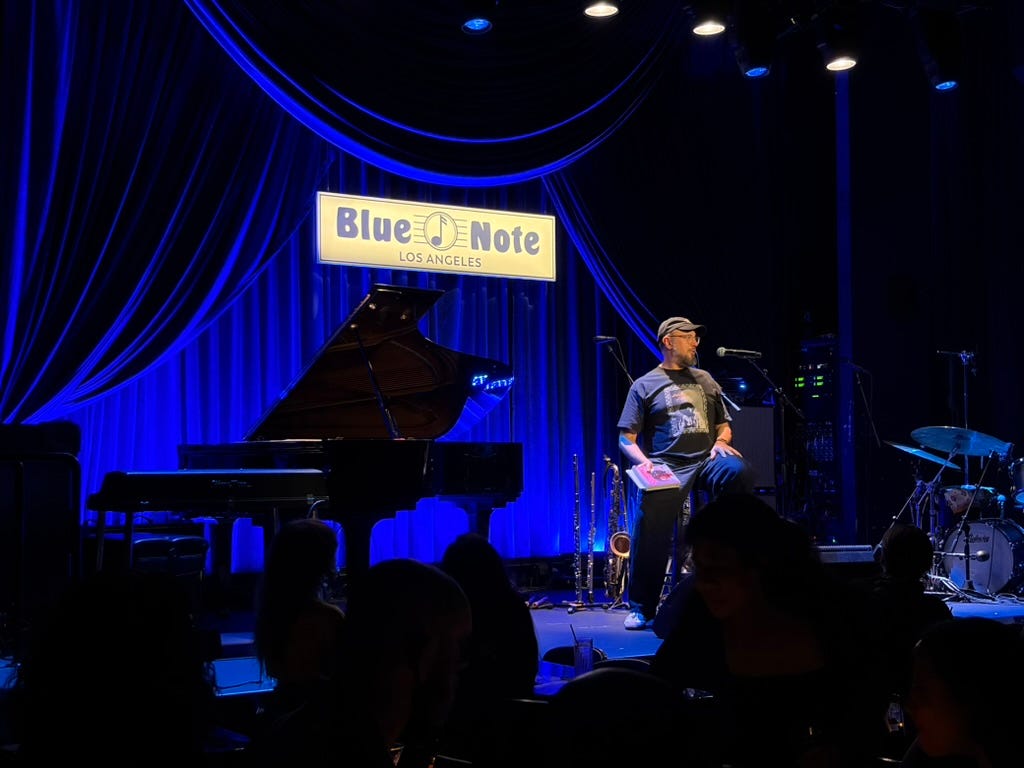
While logistically it was possible to have the plane touch down at LAX one August afternoon and drive to the Blue Note on the Sunset Strip in time for a Tuesday night event, the body, the head, the family (not to mention the luggage), weren’t really going to go for that. So about a week before leaving for a week of book events in Los Angeles, I had to rebook the flight for the crack of dawn, to give me just enough time to decompress from a family flight to the other coast, peel off the compression socks, unpack the roller bag, steam out my clothes, and situate my family at our temporary weeklong home before taking a long, sun-baked, into the maw of Los Angeles commuter traffic, the highways already reddened along the 405 and the 110. I forget that every drive in LA is a one-hour endeavor, at least. Empty the bladder one last time and pack a snack, as you’re bound to feel a hunger pang as you drive past two dozen doughnut shops no matter what your route is.
But this particular line through the cityscape felt like a familiar route to me. But it was only when I finally reached the Blue Note that I realized the venue was next to the old arena-like Amoeba. It was a pilgrimage I made from South Bay often back in 2011, when I nearly moved here. Now I can feel how time passes. The Cinerama Dome is gone. Though it has been down long enough so as to make a triumphant return. Amoeba’s original building is now all black, a shadow of itself. My memories of the city are fading in the sun.
Bennie Maupin calls me during this long snaking drive. I haven’t spoken to him in two years. When researching the book, Bennie felt integral to the story of Cosmic Music. He’s an elder, a jazz legend, but Bennie is also one of the few people who could speak beyond his own time. He told me stories about Alice back in high school, playing classical percussion in the orchestra, coming back after she graduated with a piano trio. It’s seventy years later, and there’s a tinge of awe that remains in his voice when speaking about her. But he can also speak to that time after, with his own jazz career alongside her own.
Which was rare in the research. Almost everyone had insight into one side of the polygon, few could see beyond that. The story of Bennie listening to Africa/ Brass (and also Monk Live at Town Hall) with Alice is a gem for me. It doesn’t feel like a coincidence that time with Alice prepared him for the historic music to follow. They had a sextet together, but none of that music was ever captured. “I don’t remember what it sounded like,” he confessed. “But I remember how it felt. It felt wonderful.” Bennie snakes through the humid matrices of Bitches Brew, through Lee Morgan’s sextets, and then most famously as part of Herbie’s Mwandishi band, that sextant.
The lone Alice-penned piece for sextet can be heard on Roy Brooks’s debut album.
But Bennie’s memory was beginning to bleach out. He didn’t remember how it sounded. He repeated himself often our first conversation. Asking again what the conversation was about. About Northeastern. His stories became like the ostinato that tethered those epochal Mwandishi albums: churning, cycling, revolving, never quite resolving.
In every conversation, he would mention this photo that hung in his bedroom. “I’m looking at it now,” he told me in his warm rasp. A photo of him onstage at the Santa Monica Civic Auditorium in 1973 with his longtime friend Alice and Herbie Hancock, the three of them jamming together. What would that high vibration music have sounded like that day? What did that photo convey?
I know that that historic photograph was ash. Much like Alice’s ashram in Agoura Hills was ash, much like the master tapes that she and her husband John Coltrane recorded were also ash. And Bennie’s beloved photo, the one that he gazed at every night on his bedroom wall. Ashes returned.
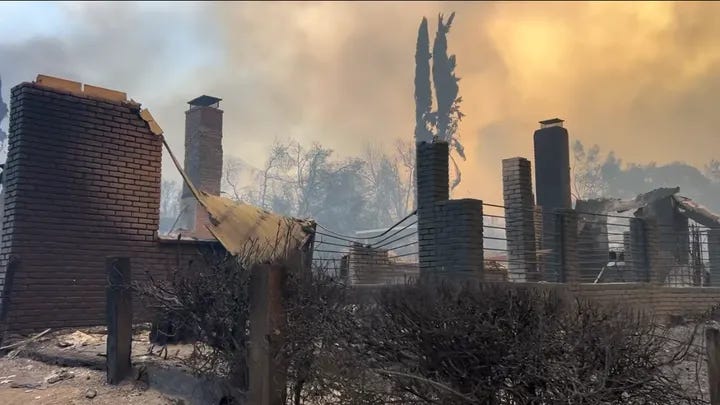
I hadn’t spoken to him since the Eaton fires that destroyed his home. I offer my condolences. We talk about the book and I invite him out. Remind him that I wrote a book about Alice Coltrane. Remind him that we spoke about his old friend, Alice. I’ll follow up the next day. Ultimately, I will not see Bennie Maupin, our conversation, our words slide back out of focus, back to the vague edges of the present moment.
If you’ve ever been to the Blue Note in New York City, the most visceral memory of the venue –aside from whatever music unfolds on that stage– is how tiny and cramped and shoehorned it is. My last time there, I could just barely see the top of Brandee Younger’s hair over the grand piano (which you know, has to be kept open and onstage even if it’s not being played that night), my elbows digging into my neighbor if I so much as clapped or turned in my seat. The Blue Note in LA sprawls in a way that feels labyrinthian. Great sight lines for the whole crowd. Get lost going to the Green Room often, discover an entire other venue with a bar behind the kitchen. It’s in this secret stage/ bar area where I see the band for the evening’s event, Phi-Psonics (Psi-Phonics? Phi-Phonics? Psi-Psonics?). We joke about the instant confusion that their band name engenders as we wait for the show to start.
Just a few hours after landing, the body still waiting for the rest of its reconstituted self to land and also drive to the venue, my longtime dublab friend, Ale Cohen, now the station director for KCRW, is telling the crowd my bio. It is weird to hear a bio of this self hanging in the air, and then I’m up onstage. No moderator, no one guiding a Q&A. I’m just here before a full room of folks to try and tell the story of Alice Coltrane and what led her to create Journey in Satchidananda.
Use this time to also talk about new aspects of the story that are not in the book, little strands embedded in there that I can now weave into a new tapestry. Like the fact that it is Alice who initiated the building of the home studio out at Dix Hills. It’s her that rings up Roy Musgnug, the Decca audio engineer who helped the Coltranes to build their basement home studio. Was this informed by Black Marxism? By Alice and John seizing the means of production for their music, establishing their own record label, building a studio where they would record and release the music as they wished?
It’s hard to affix an earthly tag like that on her, but the home studio does engender a freedom that few other musicians had at that point in the 1960s. Sun Ra and his Arkestra did plenty of home recordings (and as someone would inform me later, Chet Atkins also had his own home studio), but this home studio gave Alice the freedom to record as she was able. After the washing, after the children were in bed, after the laundry was folded, after the kitchen floors were swabbed, then –and only then– could Alice descend those stairs into the basement, to that expanse of blue carpet, and begin to put her ideas to tape.
So I play “I Want to See You” for the audience, a way to listen and hear her process her grief at the piano, highlighting her solo, the way it seems to capture the hunched shape of her sobs, just sounding those notes. Later, I’ll play “Lovely Sky Boat,” using her words to capture the timbre of the piano and harp, our perspective when thinking about the sun, sunrise and sunset but illusions, masking the fact that it is us moving towards the light.
I talk about Detroit from the start, how integrated schools led to Black and white children –as well as boys and girls– receiving the same musical education, so her start is actually in classical music. Later I would show how her classical music influence manifests in a piece like “Galaxy in Turiya.” Alice’s granddaughter is in the crowd tonight and it’s an honor to both preserve and further her grandmother’s memory, to be able to share in this honor with her present. And then the band slowly emerges and starts to play.
The band’s 2025 album Expanding To One was on my radar, but the album passed me by. So this is my first exposure to them live and they do a great job folding new material and the likes of “Blue Nile” and “Journey in Satchidananda” into their set. The music of Phi-Psonics breathes, they move carefully yet completely at ease, minding their steps down this trail. As I finish, wobble down from the stage, a place most unnatural to a writer barely comfortable in their skin over a keyboard, my daughter near leaps over a neighboring table to hug me. I feel her beaming pride for me, her hoping for yummy dessert at the end of her meal.
And then we have to run it all back for the late show, starting at 9:30. Do it all over again, try to talk about different pieces, talking about the role of the tamboura on “Sita Ram.” I’m delirious and know I still have a breezy 45-minute drive back towards the ocean. My only way to remain sane is not calculate what time it is in New York, what my body thinks is bedtime. One night is done.