
In the Fried Archives: Jon Hassell Pt. 1
From 2017, a chat with the trumpeter/ composer/ Fourth World visionary

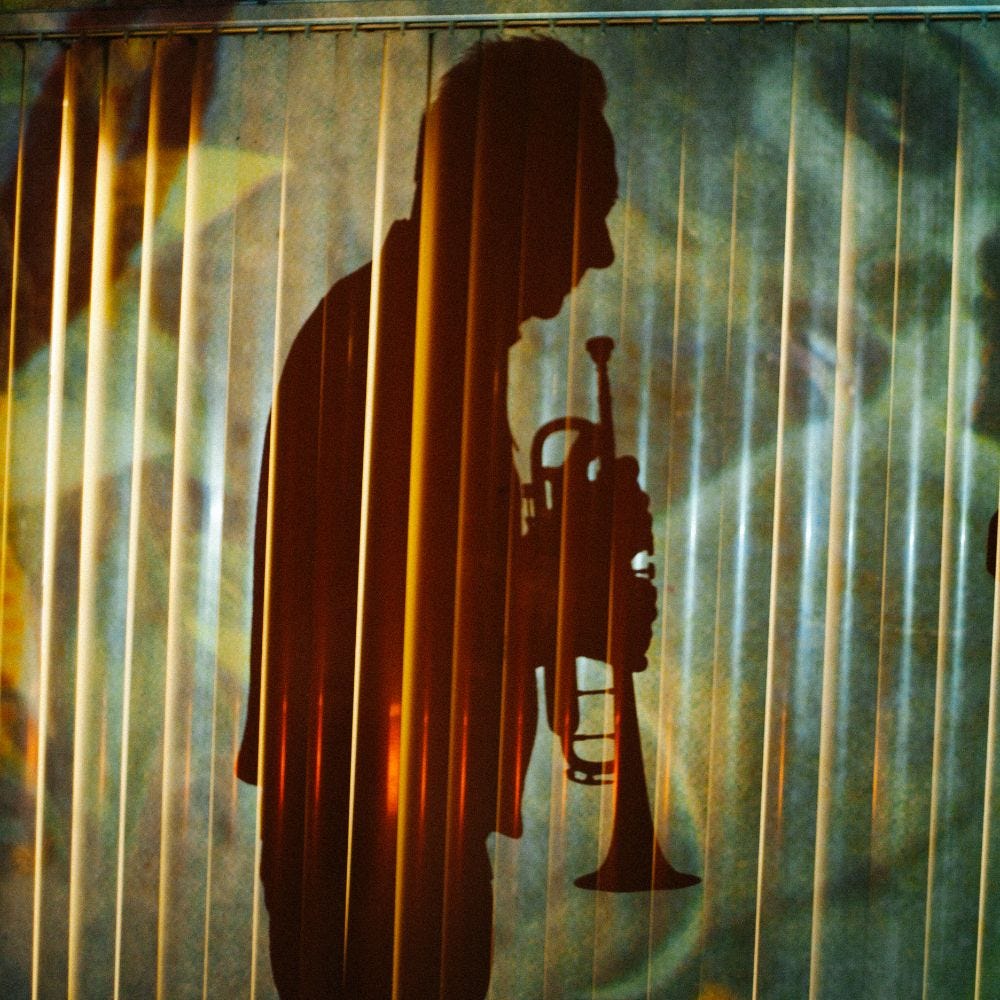
In the Fried Archives is ongoing archival series of interviews I conducted over the course of many years with some of my favorite music subjects. These luminaries range from Grace Jones to Terry Riley, Jane Birkin to Larry Heard, Yasuaki Shimizu to Mark Ernestus. A subscription unlocks access to all of the content.
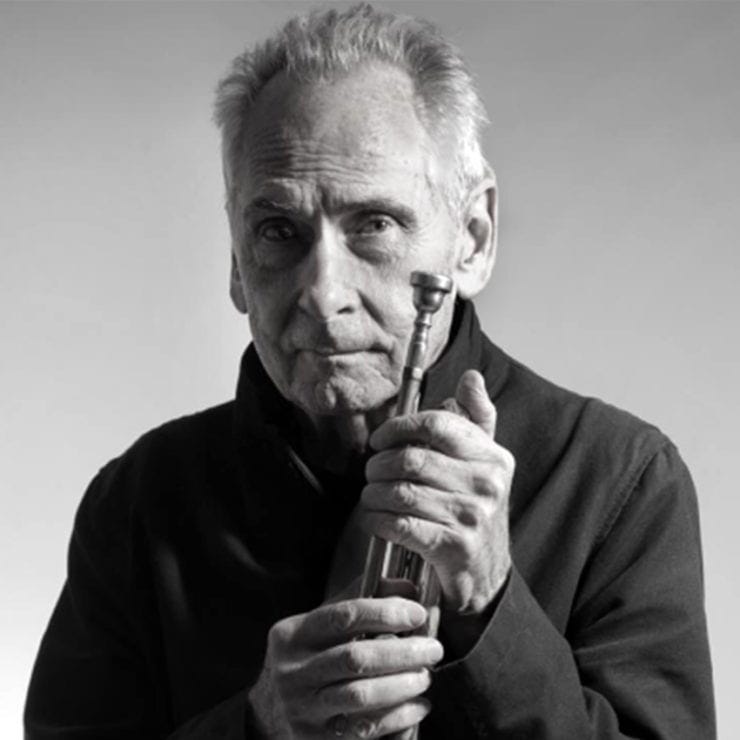
One hot LA summer evening in 2014, I found myself in the presence of trumpeter/ minimalist/ Fourth World visionary/ 20th century avant-garde Zelig, Jon Hassell. Having long-admired the man’s approach to music, it was a fairly magical encounter, done for SPIN. The headline was pretty fire, too:
“Jon Hassell Goes Below the Belt, Challenges Phillip Glass to Dance-Off”
Hilariously, the piece generated comments where people were upset with what he said about Glass (he’s not funky). But how could you deny the influence of Jon Hassell on what has since transpired in modern music? Or to be reductive and simply use one quote from Brian Eno: “Hassell’s was a music I felt I’d been waiting for.”
Hassell’s house was a few miles in from Venice Beach, the ocean breeze not quite reaching, the air hot and still inland. Tacked up throughout his modest home were Post-It notes offering reminders like “FOCUS,” “BREATHE! (EXHALE),” and an Elizabeth Warren quote. He served up sweet mint tea and watermelon spears and asked if I noticed his “plastic parts,” pulling up his white linen shirt just enough to reveal tubes that ran below his waistline, the result of a recent health scare. I didn’t really inquire about it and it’s only with some hindsight (and my own elderly family) that I now recognize the telltale tube of a catheter and the ravages of cancer treatment.
We sat in the backyard and Hassell let the garden hose dribble uninterrupted, creating shallow pools for his two dogs to lap at. It gave LA’s dry desert air a muggy feel, as if Hassell’s presence made his surroundings a bit more like a jungle than a suburban yard. As we sat to chat, he noted, “I’m surprised at how much physical energy it takes to play the trumpet.” At the end of it, he signed “For my newest friend” on my copy of Dream Theory In Malaya.
This interview however comes from a few years later, for a bigger piece at Resident Advisor that explicitly traced the impact of Fourth World on modern electronic music. When I called him a second time, Hassell was hanging a portrait of Guy Debord from 1962 in his home studio. He marveled at the similarity between the French Situationist and famed earth artist Walter De Maria (who also was drummer in the pre-Velvet Underground group the Primitives). Hassell says that Debord was “the first one to blow the whistle on the society of the spectacle, of which Trump is now the reigning emperor.” If he only knew what a hellscape 2026 would be.
That Hassell transcript in its original state was glitchy with lots of drop-outs, missed words, and garbled phrases. That’s all been corrected here.
You mentioned impressionist, and I was wondering if there’s a touch of surrealism to the concept of ‘Fourth World.’ I came across this Max Ernst quote about collage, and “The coupling of two realities, irreconcilable in appearance, upon a plane, which apparently does not suit them, where you combine these things...”, and it goes into this other realm. Was surrealism an aspect of what you were conceiving?
Jon Hassell: Oh for sure, absolutely. All of that. And you’re quite right to pull that out, because yes of course simultaneously, and all those other things that were mentioned, they were like... Of course I was on top of what was happening in art, and strange things happening, and perking my head up, surrealist things. Something like ‘Ordinary things in a strange atmosphere, or strange things in an ordinary atmosphere’. Some kind of equation like that for what surreal meant.
But yeah, no doubt, surrealism is a facet. I mean it’s still a big idea, then when I was doing the last record here, I had on my wall this big sign that said ‘I want surreal, not earnest’. So I went to go some place that was always sort of bumping myself off into something which was beyond, or was surprising, and not just college-boy earnestness, you know what I mean. Okay so where are we? Surreal... you brought me into... the WDR electronics centre in Cologne. Where was I coming from? That was coming from... the WDR Electronic Music Studio. This is after I came— well, mmm… Well, when I got granted to go to Cologne and study with Stockhausen, then of course electronic music was a big deal. All the European innovators were doing electronic, or on the sidebars was... Luc Ferrari... there were these schools developing [their own philosophies] about all electronic and...
You mean Luc Ferrari the French electronic composer?
Yeah Luc Ferrari, he was in the French school, which was about using ordinary sounds or non-electronic sounds in order to create the same thing, same atmosphere. But at that point, back in that time, there was a real divide between someone who was trying to do it all— You know, it stands to reason Germans are all about purity. Purity in electronics, and electronic sound and all that, and the French were more about the... There you go, there’s the north and south, right. The Germans, north, the French south, right?
Yeah Luc is far more south than north I would say.
Yes absolutely. So you actually know him? You know of him?
Yes I’m very familiar with some of his stuff. I was just listening to Danses Organiques, very much “below the belt” so to speak.
[Hassell relates a Luc Ferrari story that remains too ticklish to tell here]
Man, the sixties were really something else, huh?
So that was I guess the surrealism of human interactions. And that was I guess an interesting sidebar. And there I was doing things like I took just a few bars out of a Schoenberg five-piece orchestra, which was where the Fourth World concept came from. There’s a piece called “Nada-Varna.” Nada means sound, varna is color, like sound-color, melody. So the producer of this, Colombia...what was it? I can’t remember the name of the series. But he was also one of the fellows there, so one of the things we did there collectively was to record In C, to perform In C, and that was—
I’m familiar with it.
Okay. I measure that against your whole specialty –and where your whole universe is musically– and I’m just filling in wherever I can.
Wherever it sounds good, I think is where I go, musically.
Okay, well you’re very south there. You’re not worried about being intellectual, there’s little danger you’re not missing anything on the like... because somebody’s saying “Here’s an equation that will lead you to the answer to all of life”, or like you hear a siren melody, and you’re off—
Sensuality versus rationality.
—rationality. And the rationality is taken over. And we forget that... Anyway, stop me again.
Music from the Ituri Forest, Pygmy music, was just a model of the best of everything in a sense. You had old people and young people dancing and singing and making this incredible music at the same time. I was like: “This is a model for a perfect society in a way.”
So when would you say it all came together for you? Cause I know you were doing stuff with La Monte in the early seventies, you studied with Stockhausen, where does the Fourth World idea come to bear fruit?
I’m getting there, I’m getting there. So these are all components, so then I did a piece called Solid State, which actually is going to be one of the pieces that’s gonna be on my label, cause it’s under Warp right, and it was a bit like the [nada-varna] melody idea in a way, because it was like one static... that was early days of electronic music in the [tape-based] version. You know for the early days of enlisting scientific equipment to make music, but then along came Bob Moog, who is also friends with that, and came along with the synthesizer, having the electronics as an instrument. So I did a piece like that which was kind of minimalist in a sense of... but not in the— You know, Terry Riley was a close friend and a big influence on me, also this was in this New York period. When did I do that? There’s a review that Robert... that’s actually totally key to this. He’s actually the one that... what’s his last name? Robert...
Christgau?
Yeah—no. In your time.
Oh Robert Palmer!
There you go. Robert Palmer, he was actually the guy that named it in a way — well, accurately described it. He said it in such a few words, and I’m hesitating because I’m trying to turn my laptop on, trying to see if I can spot that right away. Okay, here it comes, 15 October 1977. Let’s read the first couple of sentences:
Jon Hassell who performed at the Kitchen on Thursday night advertised his programme as ‘A new crossover of music’. New is an imposing word. In music it usually is shorthand for a new combination of traditional elements, and this is what Mr Hassell offered, but he has transformed techniques from one musical idiom into another, with such skill and combined ethnic strains, electronics, minimalism and jazz so intelligently, that one cannot begrudge his use of the word new. His synthesis opens up new [vistas], rather than simply rearranging the components of old ones. Although he is best known as a minimalist composer, Mr Hassell is also a trumpet player who has worked as a performer with La Monte Young and Terry Riley.
Why don’t I just read this instead of us having a rambling back-and-forth?
He has studied extensively modern [Indian classical music under] Mr Young’s and Mr Riley’s musical guru. Rather [than keeping these as abstract] lessons, Mr Hassell has learned, learns them on the trumpet. As a result he has an impressive range of voice-like timbres, slurs, [microtonal bends] and other essential vocal mannerisms at his disposal on the instrument. Among his techniques with an evident fondness for the [modal lyricism] of Miles Davis, and the permutative concerns of a composer who has worked with only a few elements at any time, and you have a most unusual trumpeter.
I mean, I was happy to get the praise and all that, and it certainly was a bombshell, but in going back and reading it over again, like when I had to, like you use it some place and all that. I never quite got the pithiness of it, and how accurately and how completely he got the whole idea. We later became friends, I got involved with him in a project where— or I tried to organize this project for something called ‘World’s Greatest Hits’ and this was with Eno. And the idea was, to collect—
I turned on and learned to love the Ocora records, you know the ethnic recordings and all that—

Yeah can you talk a little bit about the Ocora stuff, and what sort of struck you about it, or which ones? I know something from Possible Musics has its name taken from Pygmy music. How important is Pygmy music to you?
Well…very. It was just a model of the best of everything in a sense. You had old people and young people dancing and singing and making this incredible music at the same time. I was like: “This is a model for a perfect society in a way.” You know? That extrapolation from the sheer joy of the music itself, and the complete uniqueness of it. So it’s like there are... Yes I’ve been living too long you know. I’ve already passed myself up in a way, and going back at these fucking things I have on the wall that are like... So here it is, it says on my wall:
Fourth World is a viewpoint, out of which involves guidelines for finding balances between accumulated knowledge —“wisdom”— and the conditions created by new technologies.
That’s the headline, then I’m gonna add another paragraph:
The variety of cultures, whose characteristics are tied to a given place (isolated) in the pre-media [era’s] vocabulary, and trying to think about ways to respond to our place in the new geography created by our media world — “cyberspace”. These pre-media cultures function as the elements do in chemistry, providing the relatively pure building blocks for the new compounds necessary for survival.
There it is. That’s all. I could have saved you some time.
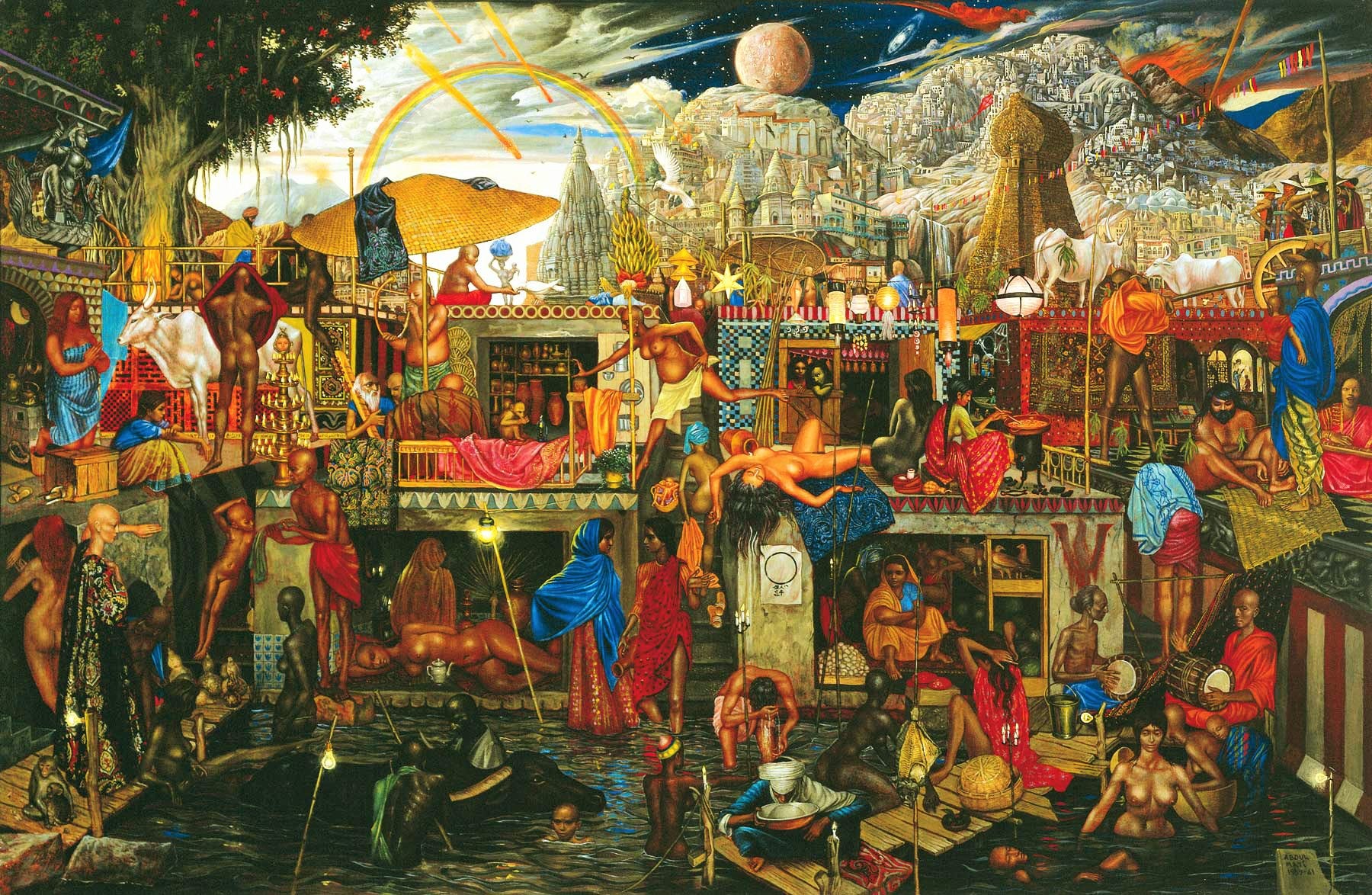
Mati Klarwein, Flight to Egypt (1959)
That’s on your wall? (I do recall Post-It Notes being everywhere, hiding behind every cupboard door.)
I could have saved you 15 minutes if I had... But this has been up on my wall for 15 or 20 years, as a kind of pithy thing for whenever I have to say something about it, but I had completely forgot about it. So anyway. The wheel has been reinvented.
Pt. 2 to follow…